Discernment and Community in the Twitter Age

Discernment and Community in the Twitter Age
A presentation for Dominican University’s Siena Centre’s Albertus Magnus Lecture series
October 13, 2011

Good Evening,
I’m grateful for the opportunity to come to Chicago and speak to you tonight … I have long admired your university in the personalities of a number of good friends that have worked here, and, ever since my own graduate education at Loyola University Chicago, the general approach of Roman Catholics to the pursuit of wisdom. There is, to be sure, a wisdom in my own tradition, the tradition that I am here to talk to you about tonight, but it is not as organized, and therefore surely not as celebrated at the work of your society and the larger tradition which holds it. So let me offer my unabashed thanks for your being you. And to … for facilitating this pursuit of wisdom in hosting me here tonight.
My tradition has a generally dim view of education. The most conservative of these groups stop formal education in the 8th grade. The most liberal of these groups sponsor their own colleges and seminaries, like the school I teach at in Bluffton, Ohio, but in order to gain education beyond the master’s level in disciplines other than theology, peace making, education or curiously business, I needed to set out on my own path and attend a Catholic School. I could have gone to a state school or a protestant school, but, really, why would I have done that? Mennonites now have doctorates in many fields, but Mennonites with doctorates are held with more suspicion than celebration in the church that we belong to.
Why is this?
It is not that we don’t value wisdom, or learning, but that the type of wisdom and learning that is valued is that which can be made plain to anyone.
Specialized theories, or methods, or equipment or cynicism; the stock and trade of all advanced academic work; are always held suspect because these methods can contain their own kind of pride, the discussions they entail exclude some people and they are not therefore generally observable, and, they might suggest an approach to the world which is doubtful rather than yielded.
Knowledge about the bible, about the history of the tradition, about how to farm, or raise a family, about how to build up community, to walk simply on the earth, to avoid conflict, to follow Jesus; these things constitute wisdom.
In my journey at university towards tenure and promotion, my service to the church in publications in church periodicals, sermons at churches, or service on church committees is valued as much as publication in esoteric academic journals. There are a number of Mennonite academics who have rejected positions at Harvard and its ilk to continue serving at a church school.
If I needed to discern the central theme in Amish and Mennonite life that informs our approach to new information technology it is something very much like what I’ve identified here: humble and plain, open and yielded.
So I’d like you to notice three things in what I’ve said so far. There is a spectrum of Amish and Mennonite approaches to similar questions. There is a general suspicion of worldly ways of doing things. I really like how you do things; which pins me on one extreme end of the spectrum.
Let me begin again; this time with a little history, so that I can locate the topics that I want to connect tonight, and give you a few points of departure.
The early 16th century was a time of huge political, social, religious, and technological upheaval. I doubt living then felt anything like living now feels, but historically the 16th and 21st centuries have real commonalities. The invention of the printing press poised society on the cusp of great change. The religious reformers of the 16th century took advantage of this change by translating bibles into the vernacular and opening up questions about the nature of religious authority.
Luther and Zwingli are the well known figures at the vanguard of this change and each saw their movements gain state support and solidify quickly into institutionalized movement which loosely paralleled the existing catholic church.
At the same time a group of even more radical reformers in Switzerland and Germany started to coalesce around several interrelated ideas: adult baptism on confession of faith (hence the term Anabaptist which means re-baptizer), strict adherence to the scripture as interpreted in the spirit’s presence in community, and a simple life marked most particularly by refusal to act violently. Anabaptists were yielded to their faith in baptism, to each other and scripture in their interpretation, and to their enemies in their pacifism. They were in the most part plain, open and yielded.
The refusal to act violently and adult baptism parts clashed starkly with all other forms of religious and social organization at the time. Adult baptism is inherently democratic and it can establish a kind of community that can, due to the voluntary initiation of its members, expect much of its followers. Pacifism has always been distrusted by authorities responsible for the maintenance of social order. These two things together suggested, probably quite accurately, that these Anabaptists could not be trusted. In 16th century Germany, much like 21st century Syria or Tunisia, this meant death to dissidents. Anabaptists were killed en masse, and the stories of these martyrdoms gave this movement both confidence in its convictions and a quietest spirit. Under the leadership of Menno Simons who saw that the movement would need to go underground to survive, the radical Anabaptists of the 16th century gave way to the Mennonites of the 17th. At the end of the 17th century Jakob Amman, concerned with lax discipline among the Swiss Mennonites of his day, led a schismatic element away from the main Mennonite church. At the beginning of the 18th century many Mennonites and Amish emigrated to this country. Their beliefs and practices were in the most part similar but developing along two parallel tracks.
The reason I can stand up here operating a powerpoint giving a talk written in equal parts on my MacBook Pro and iPad2 after having driven here this morning in my car without embodying contradiction is a set of schisms that occurred in Mennonite areas in Canada and the United states at the end of the 19th century. Educational reforms like Sunday School, increasing acculturation and technology use among Mennonites generally led Old Order groups to separate in order to preserve their communities as they knew them.

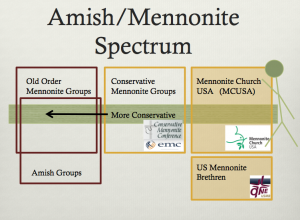
So here is a graphical representation of the spectrum of groups that I’ve been talking about tonight. All of these groups exist in decent but very moderate numbers in the USA today. There are 250,000 Amish, 40,000 Conservative Mennonites, and 110,000 in the Mennonite Church USA and 30,000 in the Mennonite Brethren. There are probably about 100,000 Old Order Mennonites but they are really uncounted.
There are four Mennonite denominations. Mennonite Church USA and the US Mennonite Brethren are the most liberal and have relationships and communications with churches both Catholic and Protestant. Then there are two very small denominations, the Conservative Mennonite Conference and the Evangelical Mennonite Conference. There are also many other conservative Mennonite groups that are not unified by any kind of denominational grouping or relationship to other churches. There are probably an additional thirty groups of in each of the Conservative Mennonite, Amish and Old Orders boxes on this chart. So, It’s not like the plurality of Catholic Religious Orders but there is still probably a joke in there somewhere. There is no Amish or Old Order denomination. There are again many different groups as the Amish and Old Orders are very schismatic often dividing over questions of technology use. The divisiveness of Amish and Old Order Mennonites is an interesting aspect of their discernment. Sometimes, almost in order to explore two different patterns of community life, a community will choose to divide intending to reunite when they can. Sometime this happens within 30 or 50 years, sometimes hundreds of years later, sometimes not at all.
The really noticeable difference between Amish and Old Orders and Conservative Mennonite Groups and the Mennonite Church USA, marked on your chart by the difference in color is that the Amish and Old Orders are plain. They wear plain dress, drive horse and buggy, or perhaps a car with its bumper painted black to emphasize its plainness. Conservative Mennonites and the MCUSA do not look any different from the rest of society. We are not plain but simple.
For all Amish and Mennonites the church is the basic and fundamental religious unit, more important than regional, national or international relationships, even if those other relationship are important. The Mennonite Church USA does meet bi-annually to conduct business by delegate session, but even the statements it issues are always seen as provisional. We think that the Apostles Creed was well written but basically we are a group of confessional not creedal churches.
I said earlier I was on one extreme of this chart. Here I am.
This rock and roll (that is, highly selective and abbreviated) history will have to suffice in order to introduce you to my people. It would be too much to develop the patterns of discernment and community among all three groups simultaneously, so let me instead seek to work on two topics in succession. First, how do Amish and Old Order Mennonites engage technology. Second, how, or should, Mennonites, for that matter any Christian, engage technology. To do this I’m going to propose three rules. These rules are genuine, in that I think they should be, in that I do them and in that they practice an approach that is yielded to technology. But the are kind of funny, and I offer them cognizant that I’m not in regular patterns of accountability with most of you. I’m easy to ignore. Having done my due diligence to the world as it actually is let me from now on use “Amish” for the conservative end of this spectrum and “Mennonite” for the other end.
I think that the interest in the Amish in terms of their approach to technology is explained well by questions like these, taken from the description of this series of lectures.
Can theology articulate ethical norms for the development and use of technology in a way that will protect the integrity of creation and the dignity of the human person? Has our culture forfeited its responsibility for prudential judgment and moral restraint in the face of dazzling scientific discovery? How do we begin to think through the potential side effects of scientific advances before moving ahead with blind optimism?
If we are really concerned about things like ethical norms for the use of technology, a forfeited culture, moral restraint, potential side effects and blind optimism, then it makes sense that we attend to a culture that by all appearances has not forfeited its responsibility to engage in moral restraint and is the very opposite of blindly optimistic about technology.
The horse and buggy is a symbol of moral restraint and technological withdrawal. However the truth about the Amish is much more subtle that this. They have not simply withdrawn from technology. They have withdrawn, that is separated themselves from, the world. Not the world as created by God, but the world of human society. The separation here is from all that is profane into a sacred community in which you are expected to do everything you can to live as if the Kingdom of God were here now. By way of the eucharist Catholics move from the profane to the sacred weekly at mass. In general, Amish and for that matter Mennonites, do this once, at baptism. All things are always sacred for the Amish, although the term sacred would come off as a bit haughty to them. The Amish use of technology is therefore all about building that community. Donald Kraybill suggests the Amish interact with technology in three ways: acceptance, adaptive, and rejection.
The Amish are happy to accept new technologies from battery operated calculators, to inline roller skates to gas barbecues as long as they are deemed helpful and benign to the community. Notice that there is no threat to community from any of these technologies.
Other technologies can be accepted if they can be adapted to the regulations of the community. Amish communities are governed by the Ordnung, an unwritten oral collection of rules and regulations that govern the life of the community. These are absorbed by young people informally as they grow up and accepted at baptism. Understandings of technology become adopted into the Ordnung. For instance, Tractors are a problem because they act too much like cars and cars take you away from your community, and isolate you while you are inside it. Some communities allow tractors but only with steel wheels. That way they can’t be taken on the road. Some communities have adapted to tractors with pneumatic tires as they have acculturated to the difference between tractor and car. These communities would all have different Ordnungs but everyone would know exactly what was accepted and not. If a member strayed from the consensus, or if the community decided that their technology was offensive, they would be asked to put the item in question away, that is, to sell it.
Technologies that encourage agriculture or business are much more easily accepted. Balers are retrofitted with gasoline engines that can then be pulled by horses. Pneumatic powered tools are becoming more an more common, typically running off of gas generators. Electricity is run to barns (but not houses) in order to keep milk cold to meet state regulations. In each of these cases compromises are made in order to either allow farming to continue or to increase agricultural efficiency without changing the mode of agricultural production.
The Amish will quickly reject technologies that will likely be detrimental to the community. Communication technologies are more carefully screened than any other type of technology because of the connection to the outside world and its corrupting influences. Television’s one way conduit into the home is probably the most egregious example of a corrupting influences. I know many Mennonite homes that won’t have a television for the reasons that there simply isn’t enough that good to watch on TV. The similarity between a television and a computer monitor is one of the primary reasons that computers were initially suspect. Like the old joke that Mennonites won’t have sex standing up because it might lead to dancing, the Amish initially rejected the computer not because of its own potential problems but because it seemed too much like television.
Kevin Kelly suggests four aspects to how the Amish make decision around technology. They are selective. They evaluate new things by experience instead of by theory, and they reject more than they accept. Innovators pioneer the adoption of new technologies but the community makes the final decision. The maintenance of the community and separation from the world are the leading factors in making these decisions.
These factors end up with a situation in which for at least some Amish, technological experimentation is the rule and not the exception. Electricity is typically banned because it connects the community to the outside world and creates an unacceptable dependency. Some innovate by utilize electricity that comes from 12 volt sources from batteries rather than 110 volt power from public utility lines. Others use gasoline powered pneumatic technology is then adapted to run anything from kitchen blenders to entire wood shops.
Note the importance of surveillance in this example. The Amish are not, at any point, going to create their own batteries or gasoline. But gasoline is a consumable that can be purchased, along with other supplies, and used in discrete amounts. At least part of the problem with electricity is the wires that run from the road to the Amish persons house. The plainness of the Amish life is very environmentally sensitive, but environmentalism is not the point, community is.
Surveillance is also important in thinking about the use of telephones among the Amish. Having a telephone is not necessarily a problem. It facilitates business calls and can be helpful in emergencies.
The Amish do not want to depend on the world, but they are not fatalistic either. They will use hospitals even receiving expensive advanced care. They won’t hold health insurance, preferring to pay in cash for the services rendered. Sometimes, the community needs to extend a broad net to collect enough to pay a bill. Individual debt is no problem for the Amish, as long as it was not incurred by the individual.
Having a telephone inside your house allows for non-surveillable telephone conversations. Having a telephone shack built out by your shop or barn is more open and yielded. Some of these phone shacks can be very nice built with space for more than one person. It can be nice to have someone wait with you in the rain. These conversations need to be scheduled in advance. Cell phones then create an interesting quandary. They are even more surveillable, as anyone who has ridden on the CTA knows. But they are also much more individualistic, which is not a good thing. The community member who only uses their cell phone in the presence of others would be even more virtuous than the person who talks in a phone shack. Still, most telephone calls are to the a business contact in the outside world. Telephoning another Amish would be seen as detrimental to the community because it replaces a visit. The Amish look to innovators to test new technologies and the innovators, often people who really enjoy technology, get to use the new things for at least a little while. The innovator needs to be careful though because every member is also the reputation of the community. The Amish person becomes who they are through interactions with other people.
The responsibility for managing this experimental consensus and overseeing the Ordnung lies with the bishop. A functional bishop does not set the direction for the community but rather knows what the most conservative member think and moderates a compromised position that accepts, adapts and rejects according to what the whole community can live with. I say compromised, but yielded would be a better word. The best general example of this is in the pattern of use rather than ownership among the Amish. Many will much more easily use a technology than own it. It is much easier to be yielded to something that you don’t own.
Finally, its important to note that there are points in which the Amish as a group are technological pioneers. I mentioned earlier that the martyr stories are very important to Amish and Mennonites. These exist in a book called the Martyr’s Mirror. In 1745, Jacob Gottschalk, the first Mennonite bishop in the Americas, arranged with the Ephrata Cloister to have them translate the “Martyrs’ Mirror” from Dutch into German and to print it. The work took 15 men three years to finish and in 1749, at 1512 pages, it was bar none the largest most technologically significant publishing venture in the Americas. When the technology is needed, there is not hesitation, even among the most conservative Amish to employ it.
The technology then is never evil intrinsically from an Amish perspective. In this way they have absolutely no Luddite tendencies. Technologies are all simply instruments which are either used for ill or for good.
It is helpful here to make a distinction between instrumentalism and determinism in reference to technology. To put it simply, determinists believe that technologies have inherent values. Our tools shape our use of them for good or ill, perhaps more than our intention. Determinists believe that the fast pace of our society is because our tools promote speed. Determinists believe that guns kill people. When people don’t think about how they use technology they aren’t going to be able to control it. It will control them.
A strict instrumentalist believes that technologies have no inherent value. How we use the instrument shapes the morality of its use. Guns don’t kill people. People kill people. Cellphones aren’t irritating, people who use cellphones are irritating. Partly because I am very optimistic about the possibilities that come with new technology, I think that the best thinking about technology is modified instrumentalism. I do definitely believe, with the determinists, that some tools shape their users. The difference between the gun and the cellphone is important. Guns are only good at killing people or at least injuring people. When guns are used for protection, defense, or safety, they do so by killing or threatening to kill people. Guns have determined uses. Cellphones are less determined.

An Amish person would never develop this philosophy of technology but in the end we would be in quite close agreement about how to make decisions.

There are many similarities, I think, between how I think about technology and how an Amish would. The key difference is that my community does not become offended by my technology use. People make fun of me when I play video games, but noone suggests I stop, or play differently. This is the difference between plain and simple. This is perhaps where we have forfeited our responsibility, by not calling each other to account for how we use technology.

So, how do we get it back?

Accept, for the purposes of this evenings discussion, an argument that I want to make but don’t have time to develop. The yieldedness of the Amish from technology to allow for the unencumbered forming and maintaining of community is analogous to the yieldedness of a Mennonite to technology in searching for technological utility in forming and maintaining community. You can substitute in any other faith for Mennonite in my analogy but you need to retain a focally central community.

If this analogy holds then the responsibility of our community is to find ways to use the technologies that we encounter to build rather than isolate ourselves from each other. I’m going to talk about three technologies that are relatively new and suggest a few rules for using them as a way of concluding this talk.

I’m not going to talk to you about facebook because Cathi Falsani did that last year. But I think you should all have facebook accounts. Here’s why. We think that it is responsible for details of our lives to be kept private from others. And, in some ways, privacy is really important. We need to protect our children and other vulnerable people from exploitation and the kind of information you can get on the internet surely facilitates some kinds of exploitation. But in general, I believe that the question of privacy is a red herring for Christians. We should not have anything to hide. On the contrary we should want everyone to know and be converted by our lives. This is why I think that every Christian should be on facebook.

Using facebook as it is now is not particularly virtuous, but we have difficulty in the church with privacy, with individualism and with money. Would it be a good discipline if we again shared, as I’ve heard we once did, our yearly income and tithing? What if churches built a small web applications to add to our facebook pages that reported our individual income to other members of our small group, congregation or diocese. Or if we didn’t want to use facebook, what if this kind of functionality were standard on church websites, even if it were in a members only system. My point is that the kind of sharing that facebook encourages could really strengthen bonds of Christian friendship and accountability in important ways if people committed to using the technology carefully.

Twitter took the internet by storm a couple of years ago. It is made for cellphones since all it can do is post messages 140 characters in length, or less. I’ve noticed that when I read something that comes from someone I trust I am willing to spend much more time on it. Twitter, at first glance, might seem like the worst offender in the contest for dividing up my attention, which can be a problem with the internet as anyone who has read Nicholas Carr’s Is Google making us stupid knows. But on the day of the awarding of last year’s Nobel Peace Prize I was reading things written by Liu Xia wife of the awardee Liu Xiaobo. The best coverage of the fall of the Tunisian government was hosted by the quirky website boingboing. People I respect on twitter had compared various coverage and posted this. It became easy for me to read exactly what I wanted to on the subject. This was for me much more dramatic on the night Osama bin Laden was killed. Because of who I follow I mostly read calls to not glory in a human beings death.

Of course the role that twitter itself played in the actual fall of the Tunisian government is much more significant. Youtube, facebook and twitter convey information and ideas at light speed around the world. The internet is probably the most important tool in making globalization happen.

It is also a tool of destabilization for governments the world over. Inflexible regimes like the one in Tunis fall and twitter is as important a tool in doing this as any other single too. Stable, flexible governments like Sweden or Switzerland aren’t affected as much. It remains to be seen how countries like ours will fair and the Occupy Wall Street Protests are a key example of this. One thing that is really interesting about the Occupy Wall Street internet presence is that it is driven in part by twitter, but twitter is also an instrument in spreading confusion and misinformation about the protestors. A twitter mob is easy to start if people join in, but a twitter counter-mob is just as easy to start if people join in. A number of the hash tags that people have used to spread information about Occupy Wall Street have been coopted and spread confusion rather than instruction.

To the extent that Zine El Abidine Ben Ali was an evil dictator, I’m glad he’s gone. If regime change means a better life for the poor, the widow, the orphan and the alien in that country we can be grateful to twitter. However in the end, as Christians, while we are concerned about the world we should not place our hope in twitter. Our hope in is God. Still, if we learn how to use it twitter might become a better news source than CNN, NPR, or the Vatican. It could do this just because it combines information for each of these sources. Should we insist that our leaders tweet? Christians need to be able to talk publicly about their faith. Our leaders already need to be good at this. So one of my rules, but I say this somewhat tongue in cheek, and only with respect, is that the Pope should tweet. I also think that the President Carroll, Vice President Kennedy, Provost Johnson-Odim, Dean Carlson, and other thought leaders on campus should tweet as part of their jobs. These should not be purely information accounts. They should be both personal and professional.

My last rule, is that you should play or that you should watch someone with more experience play Glitch. I suggest Glitch because it is social, free, non-violent, and highly imaginative. Actually, any Massively Multi-Player Online Game will do. Next Tuesday you’ll be able to play as a pet on The Sims 3, and there are priest characters on World of Warcraft. All you ever have to do is heal. These environments are typically very highly developed and very compelling. I remember once after having spent much time navigating the world in World of Warcraft in my night elf priest avatar (a really tall character in the game), navigating the world in a gnome avatar (a really short character in the game). At one point you need to get onto a boat. I felt viscerally like I was going to fall in the water because my legs were too short.
Before you think that I’ve come totally unhinged, consider the importance of practice and imagination. The Christian life is one that demands great imagination if it is to be done well. This is all the more the case when we try to live this life in the world. To some extent the great virtue of Amish life is that it contains the imagination. The imagination of the Amish community is real but bounded in ways that mine yours simply isn’t. How can I practice at having an unbounded imagination? One good way to exercise my imagination is to interact with others in a virtual space. Jane McGonigal, in her book Reality is Broken, suggests a number of fixes for our real world that playing games effect.
Let me list just a few
• Compared with games, reality is too easy. Games challenge us with voluntary obstacles and help us put our personal strengths to better use.
• Compared with games, reality is depressing. Games focus our energy, with relentless optimism, on something that we’re good at and enjoy.
• Compared with games, reality is lonely and isolating. Games help us band together and create powerful communities from scratch.
• Compared with games, reality is unambitious. Games help us define awe-inspiring goals and tackle seemingly impossible social missions together.

Rich online environments, like those found in good Massively Multi-Player Online Game, have real benefits. For instance, an important part of my Christian life is my pacifism. Games like Glitch could be a good opportunity for me to get practice at virtues like pacifism that are hard to practice in the everyday world. Imagine if games put me in situations that I didn’t anticipate but could navigate without using force. Glitch does this. Could I carry my skills from the game into real life? Well, NFL football players have been adapting their real world game play based on skills that they have learned by repeated playing of their own characters in games like Madden Football. There was a runner who burned time on the clock in a real NFL game by running along the 1 yard line before scoring a touchdown; a move which would have only seemed like risky grandstanding had he not discovered how well it worked in the video game.
These games are also very social. The computer manages the participation of a massive number of simultaneous real world participants. If we all had laptops could all go onto Glitch right now and play together, interacting with each other and many other people in the game world. How would this shape our interaction with each other. You might be sitting by someone you don’t know right now. But you probably aren’t going to talk to them after my lecture. A game might make you practice modes of interaction that the Apostle Paul avers for all Christians. It might show those modes of interaction to many many people.
What would it look like if churches held a annual game playing day? Experienced and novice game players could gather for a day, play, but then talk about how community was formed or maintained by the day. What if the results of the day led to decisions to then use or refrain from using particular games. I’ll admit that I don’t know of Christian communities that do this. And we can’t count on the Amish here. There is a seriousness and boundedness of their pattern of community that is not open to this type of discernment or play.
Actually, in some ways I think that in the stewardship of your imagination you are already somewhat ahead of me. Your university has a Vice President of Mission and a Centre like this one where you can explore ideas like this and keep your mission and purpose close at hand.You can explore the possible uses of science and then discern it’s use in a community. Blessings in this work and in all that you do together.

entitlement

so, i don’t know anything about parenting, but I was talking to my sister (we both teach college) about the way that students can seem really entitled these days. (a student disagreed with her about a hard rule by saying, “agree to disagree”) and so we wondered about why parents spoil their children. and she mentioned the comment of a friend that suggested guilt. and that was interesting to me because when i think of the differences between what my parents had and what they gave us it makes me recognize that no matter how much i whined about wanting things my parents knew i would survive; they had on much, much less. but if i’d had kids and they had whined, i might have wondered about how much i could give them. i really had everything i needed and more. i might have badly spoiled my children. they might have ended up entitled. that would suck for their professors.

neko cat: understanding symbolic representation

In my house, with the addition of neko two weekends ago, we have been shifting our patterns of life, as people do whenever we add a new person to our families. We have been learning, and re-learning, many of the patterns of feline-human personal interaction. One of the most interesting new learnings has been neko’s particular gift for understanding symbolic representation.

When is a mouse a mouse? This question raises a particular problems in metaphysics,  ontolology, language, and taxonomy. The question depends greatly on your perspective, of course. From the mouse’s perspective the question is at least about who I am comfortable around.

Cave - Mouse Nest 2

From the animal researcher’s perspective, a mouse is a highly controlled commodity often with genes that have been manipulated in one way or another. One interesting “strain” of “mouse” in this context is the “humanized” “mouse” whose genes have a human gene knocked in.

It seems like a mouse’s mouseness is in the last example is something that humans seek to control. A mouse in the wild is not a good “mouse” in the lab. And I imagine that representations of mice in art are often thought of as linguistic in this way. We arbitrarily call the thing that looks like a mouse a mouse even though we know it is not really a mouse.

Here are two of these mice. The one on the right is a SmartyKat Jitter Critter, which has been dosed with catnip, and is “intended” as a cat toy. And I’m pleased to say that it works pretty well. The main question that I’m interested in at this point is why it works well. Does it work because it is dosed with catnip? Because it is soft and open to feline destruction? Because it looks like a mouse? My guess is that most people are fine with positive answer to the first two questions. But most people think that this mouse’s mouseness is incidental to its success as a cat toy. From the cat’s perspective, this is probably not a mouse. On the left we have a metal mouse given to us as a decoration for our house. The only resemblance that this mouse bears to the Jitter Critter is in its shape. However, Neko likes playing with it just as much.

Now this video does show her playing with the Jitter Critter … but right after she had been playing with the metal mouse which is on the floor having been knocked off of its ordinary perch. It seems that for Neko, mouseness is all about looking like a mouse.

overgiving

What holds true for the soil-that you must give it more than you take away-also holds true for nations, institutions, marriage, friendship, education, in short for human culture as a whole, which comes into being and maintains itself in time only as long as it cultivators overgive of themselves      - Robert Pogue Harrison in Gardens, p. 33.

My students, but I only start with them because they are in the position, professionally, of trying to understand, often have difficultly with the concept of an economy of abundance or gift. How is it they ask that the true economy is not one of scarcity when that is all we can see. My example is always forgiveness. There is never a limit on how much we can forgive, nor on how often we can be forgiven.

But perhaps the better example is gardening. The true gardener for RPH is the person who is able to pay attention to, and to cultivate, the soil. It is in reference to the soil that he is able to say that you must give more than you take away. The true gardener delights in the soil, in the soil’s ability to grow plants; but with a focus to the soil not in anticipation for the plants. And this is perhaps how economies of abundance work. To participate we must give more than we take away. But if we do this, we will (hopefully without expecting), receive more than we could have imagined.


metaphorical crucifixion, triple AAA rated

sometimes i think that the crucifixion must be purely metaphorical. here’s what i mean. i don’t mean that it didn’t happen. i believe in the historical crucifixion. but i also recognize that it’s really difficult for that brute historical fact to have much practical meaning for me. whatever it means it doesn’t mean that I seek crucifixion for myself. i need to follow jesus, even unto death, but seeking to imitate the pattern of that death has been wrong at least since ignatius of antioch.

so i think about the world that i live in. a world that exists without crucifixions except in the most bizarre of instances. and i think about what lead jesus to the cross. and i think that at least part of what lead jesus to the cross was a dogged determination to speak truth to power. and i think about the nature of that power then and the nature of that power now. and i think that that power is represented no more clearly than in the hubris of Standard and Poor’s who this week despite a 2 trillion dollar error in calculation downgraded the USA’s credit standing. this is the same Standard and Poor’s who choose not to downgrade the credit standing of all those companies who were burdened with tons of toxic debt in 2007. i count it as pure evil when you choose to play with reputation in this way. it could make a real difference in the lives of the poor if the USA finds itself financially encumbered. the country as a whole is in a real way the last resort for the financial system. if you want to protect the poor you should prop up their last resort as much as you can. when you choose not to do this right after you have protected the wealthy (i recognize the domino effect argument and stuff. but the USA has to always be the last domino, right??) you are evil.

so what does it mean to me, in the wake of the lunacy and evil in our financial system that jesus was crucified? well, since it seems pretty clear that jesus was crucified so that i don’t have to be, it doesn’t mean that i need to seek my own financial ruin in response to the evil of the system i happen to live in. i am freed, by the blood of Christ, to seek a different path, that is simultaneously a following of Christ just as it is it’s own liberated thing.

i think that anyone who takes the time to really care, in the midst of the evil i am trying to describe here,  loses their happiness in cloud of despair. the poor die and the powerful find new ways to kill them. but i am freed from this despair, freed to what? to anesthetize myself against reality? this is a pretty good option and the prevalence of great new cable shows that have summer runs (i’m thinking in plain sight, white collar) work pretty well for this. i could play video games? this is an even better option, especially when it is, as jane mcgonigal writes, the way for me to discover a new better reality and to fix my world. more and more, though, i think that it must be the pursuit of beauty. i think that the transmutation of Christ’s suffering into the beauty of my freedom is the most heartbreaking and liberating reality that has ever existed. this is the metaphor of my salvation. it is not an easy path to follow when the ugliness of Standard and Poor’s is thrust in front of me every day. but that is the path that follows best jesus.

Witness to Love

Sermon for Chicago Community Mennonite Church

Good Morning,

It is good to be back with you this morning after an absence that is longer than I’d like. They say absence makes the heart grow fonder, and I guess that’s the case in the relationship between the licensed theologian and his congregation. It’s not that I’ve lacked for good church; the community in Ann Arbor that Susan and I frequent and have become involved in is a solid good group. And I’ve found that playing in the chapel band at Bluffton has given me a connection to the worship that happens in that space that is deeper than in my first six years there. If it sounds like i’m romanticizing my relationship to you a little bit, well, that’s exactly right. For, like someone who reflects on his first kiss, I have fond memories of how you have taught and continue to teach me how to love.

Soon I want to spend some time reflecting on how EB will teach us and be taught love here. But first let me share, as an aid to memory for some, and as a story for others, two stories about intense realizations of love that I have felt in this church. The stories both end the same way and I’ll give away the ending to both up front. I end up bawling, crouched in that pose of retreat that only men who never cry assume; having been wrenched out of composure by a power which leaves me without control over anything. This happens in the middle of Sunday morning worship and no one knows what to do so people just keep on worshipping. Someone holds me, probably Susan, but in that moment I wouldn’t be able to tell you. I only know that it is a member of this congregation.

The first story happens here on a morning when we are celebrating the realization that we are a good church and that the persecution that we as a group have been receiving during some unpleasant conference meetings is not something which needs to define us. We are a church who has as its job to be the church and that means much more than defending ourselves on any particular issue. We are about welcoming, providing sanctuary, and loving each other. On that day we knew that Jesus was in God, and that we were in Jesus, and that Jesus was in us. We knew that they who have Christ’s commandments and keep them are those who love Christ; and those who love Christ will be loved by God, and Christ will love them and reveal Christself to them. I can remember a palpable sense of relief and new purpose that seized us when we decided that we could be the church even in a world, or more heartbreakingly a church, which seemed sure that we weren’t. Anyways, on that morning Joanne Zimmerly and Julia Friesen, accompanied by music, danced into the sanctuary from that door to the altar with our quilt. I didn’t recognize the quilt at first as the back, which was what we could see at first, is quite plain. But then they opened it; tentatively at first, but then in its full glory.

The brightness of the quilt struck me the heart and I started crying filled by a sense that I belonged to something so precious that only God’s grace could have brought me into it. I learned that morning that love finds a purpose in communal celebration of the possibility of being the church. That while it may not seem like it sometimes, the church really is the body of Christ. That this is a body that lives and breathes and loves and dances. This is a body that woos us, offering us a love that we do not deserve but that is nonetheless vulnerably extended like the tender embrace of new lovers. The church is a tender witness to what is possible when we love God.

The second story is a story that happens at Camp Freidenswald during the church retreat. It’s about 10 years ago. Seth Andreas-Wiebe has just been born and it is time for his dedication. It is also just after Susan and I have given birth to the shape of the knowledge of our family. That’s not a phrase that you hear very often so let me explain it.

Susan and I are unable, biologically, to have children. We, at one point, underwent a variety of fertility treatments, up to and including two in vitro fertilizations, but never accomplished a pregnancy. During the time before, during and after these treatments we sought out the wisdom and support of this congregation. We received a blessing at the beginning of these treatments, slept under the quilt while the treatments were happening, and after the treatments we had not given birth to a child, but we had given birth to knowledge of the shape of our family. We were not people who had children but we would have opportunities to build relationships with others, like my students at Bluffton for instance, in ways that could be more deliberate that people with children can. So since we had given birth the church threw us a shower. We received plants which grew outside our Chicago home, our Bluffton home and are now growing in Ann Arbor. We had a cake, chocolate, which was crumbled up, put in a flower pot with gummy worms and had a bunch of mint planted in the top. It was hard to eat but it was the perfect cake for our shower.

So, a month before, or after this shower, I’m not sure which, Seth was dedicated. Pastor Phil Waite took Seth and lifted him up and I saw him shining in the light that was pouring in the big windows of the A-Frame at Freidenswald, which is incidentally the same space that Susan and I were married 17 and a half years ago.

The brightness of Seth’s skin struck me to the heart and I started crying filled both by the sadness that my child would never be held up in the same way, but also by a sense that I belonged to something so precious that only God’s grace could have brought me into it. I learned that the love a congregation shows its members can transform itself fitting each person in ways that are best suited to that person. This is a body that is made up of many different parts and at its best knows that about itself. We don’t always succeed at doing this but in moments when we can value the birth of babies and knowledge in the same way we offer people a love that is deserved but rarely found in a world that values certain types people, certain types of knowledge, and certain types of love more than others. Very different things become the same when God is the author of our love. Or perhaps put better, very different things are authored by the same God through love. The church is a bold, bright witness to what is possible when we love God.

This is at least part of what Paul is after at the Aeropagus when he connects worship of an unknown God to the God of Abraham, Esau, Rahab, and Ruth. Paul asks the Romans to rewrite their history in today’s scripture passage. The God that they have thought of as unknown he now wants to make known. Paul’s suggestion is revolutionary. The world that the Romans have known is turned upside down. Each of the stories I am telling you this morning are revolutionary in this way.

Seth’s dedication brings me to the dedication that we have just witnessed. What kind of love is EB learning this morning.

EB? What is your idea of love?

Do you know it as the unfurling of a quilt? As the shining of skin?

Probably not. And this is appropriate. The stories that I’ve told this morning are crucial stories in my understanding of what love is, but they are my stories. They are woven into my particular life and make up my particular understanding of what love is.

EB you are a month old. Love consists mostly in feeding and related events, perhaps in the gentle rotation of a black and white mobile. You do learn something about love today, at minimum, and however fleetingly, you learn today that this room is a place where your parents might give over your care to other people. (You learn this in a bodily posture that is identical to the bodily posture that I adopt when I learn about love. Bawling. We don’t have control over how we learn do we EB?)

But love won’t always mean this for you EB, love will start to mean other things. Soon you’ll have a sense that your parents love you almost or even entirely unconditionally. The things you’ll get away with! Your love with your brother might take a different tone, at least at first. You’ll learn about the love of friends, of this community and perhaps others. At some point, love will take on the new meaning as you’ll be hit in the gut by the attractiveness of a new singular person. You’ll contrive to spend time with them. And, in all likelihood, your heart will also be broken. This will also be a learning about love.

Herbert McCabe says, “A large part of of the business of growing up consists in recognising the complex forms that love may take and – this is important – being open to the possibility of new forms. ‘Love’ is thus what we might call a growing word, one whose meaning changes and develops … Knowing how to use this word is an essentially historical or autobiographical matter. I mean when you have achieved some skill in the use of the word, you cannot simply hand over your results to someone else; (that person) has to live through the whole business (them)self, starting with the simplest and crudest understanding … there are no short cuts to understanding what love is.”

Each of us needs to undergo the work of understanding what love is. Does this mean then that the meaning of love is totally random? That love will simply be the sum of my experiences with it? Partly this needs to be true. Only my sister also has Grace Bechtel for a mother; no one else is married to Susan Hunsberger; and only I have my set of unique and particular relationships. But love, this growing word, is rooted for me in experiences that other people share. Other people shared the unfurling of the quilt and Seth’s shining skin. Love is about the content – about what love is – but importantly perhaps the meaning of love is perhaps more about how it is given witness to. The meaning of love is the meaning that a community shares. So perhaps what is so significant about love is not its intensity or its way of binding people together. The significance of love is how it can take on deep meaning for a group of people and for individuals and how it can do this in revolutionary ways.

The best example of this is of course Christ’s death. Jesus come to earth to teach how to love and to love in the most perfect way possible. The inevitable consequence of offering perfect love in a sinful world is death. The remarkable and revolutionary aspect of the crucifixion is not in the shape of Christ death but in the resurrection in the revelation that a lived live in love is in tune with the deepest purposes of God’s universe.

I’ve told you two stories about my journey and how it has been turned inside out by learning about love that are peculiar. The resurrection provides the paradigm of this kind of deep meaning making. The church, in its rituals, also finds reliable ways of doing the same things again and again that attempt to elicit the deep meaning for its members. We are doing both of these things this morning. We have dedicated a child into the care of the church. This is a commitment to again and again provide opportunities for EB to make choices to follow Jesus.  The depth of the meaning of this commitment is it’s orientation towards death but the kind of death that represents perfect love. It is strange that we would dedicate a baby towards death, and if we were infant baptizers this meaning would be intensified. Perhaps one of the reasons that adult baptism stuck as a practice for us is because we recognized it’s inevitable orientation towards death more acutely than church who weren’t experiencing the same kind of persecution that we were. Perhaps not.

The other practice that reliably orients us towards the deep meaning of love is communion in which we remember Christ’s life, death and resurrection. We’ll celebrate it now and as we do we could also remember our own histories and revolutions in understanding love. I could tell you the story about the time I was responsible to bring communion bread and the only loaf I had was frozen onion bread which didn’t thaw and burnt my hands as I struggle to offer it up on Sunday Morning, but I still haven’t found the meaning of that one. Amen

How to solve the budget. (the budget doesn’t need solving, we just need new media)

All corporations and individuals, except for those making less than $20,000 a year, pay 10% tax on gross income (whether it is from salaries, wages or investments). All corporations and individuals who make more than a million dollars pay a 2% tax on gross income above a million dollars. If you get caught cheating you pay 30% for 3 years.

Defense spending is pegged to GDP and you aren’t allowed to spend more than 25% on it.


Health care costs get split into two systems: one public, one private. Creating these systems is easy. The hospitals that the government already owns (including through state universities) are the public ones. Public health care has some costs that are fixed. Everybody that works at a public hospital makes between 50 and 250 thousand dollars. Everyone who makes less than $20,000 gets free health care. Everyone else can enroll in a government sponsored high deductible plan. Government subsidies for health care can’t exceed 20% of GDP. High cost end of life care and high cost lifestyle care (treatment for your cancer if you smoked etc.) are the first things that gets rationed in the public system.

Update: disregard everything in this post and read this: http://www.thepeoplesview.net/2011/08/paul-krugman-is-political-rookie-or-how.html

August 1

Today’s august 1st. I hate august for the way it heralds the new school year and the end of summer. I like coffee. I don’t enjoy my coffee as much during the school year as I do in the summer. I’d intended to start blogging again today because I think that I just might really be a blogger, but my computer is almost out of powe…

My brief introduction to ethics. Chapter 1

Happiness: An introduction to the Good Life

Happy are those who mourn, for they will be comforted. - Matthew 5.4

The Beatitudes, a set of short statements that Matthew reports Jesus as saying at the very beginning of the sermon on the mount, will form the backbone of this section on ethics in a biblical worldview. Each one of these statements is about a person or group of people who are surprisingly happy as in the beatitude which opens this chapter. At least as far back as the Greek philosopher Socrates happiness has been at the heart of how wise people have understood ethics.

My favourite story about happiness is told in the film Life is Beautiful. It is a story about an Italian Jewish family in the second world war. In Life is Beautiful the family has much to mourn, but through the father’s persistent happiness his son is able to find comfort. I believe that stories are the most useful way for us to begin to learn about ethics in a biblical worldview. I believe this because I believe that the Bible is itself first and foremost a story and so if we want to think about the Bible we need to learn to think in stories.

In the rest of this chapter I want to tell this story and connect it to Jesus’ Beatitude about mourning and comfort. I also want to introduce the rest of this section of the book. But first, let me say a bit more about the thesis of this chapter, which I’ll restate here: I believe that stories are the most useful way for us to begin to learn about ethics in a biblical worldview.*

Introduction: Believing with/in Authority

Stories other than Life is Beautiful might be useful too, but I believe that we need to think in terms of a story when we are learning about a worldview because worldview are stories that we tell ourselves about our world. I also believe that as often as we can we need to let ourselves be guided by stories when we are trying to be ethical. In particular, I believe that stories are more useful than goals or rules for the person or community who is trying to be ethical. I believe this because I believe that only stories have the richness to help us think about the complexities in our lives. Stories have the strength to sweep us up in their narrative or flow of events so that we could imagine ourselves actually living in the story. In addition to being strong in this way stories are also non-coercive. That is, a story very rarely forces us to think or believe or do anything. Stories are so useful for people who want to think about ethics because they are strong (complex) and voluntary (non-coercive).

Not everyone believes that stories are so useful for ethics. As I hint above there are at least two other ways (goals and rules) of thinking about ethics are in reference to the Christian religion. We’ll explore these in more detail later. For now, I simply want to note that while I am stating what I believe to be true other reasonable people disagree. Furthermore, I can not prove (in what we might call a mathematical or scientific sense) that it is true. The world of ethics is not black and white. Does this mean that there is then no truth or that truth is merely a private matter so that what I believe is true for me but can not be made to impinge on other people’s lives? This is an important question and we will take it up again and again in different ways in the chapters that follow in this section. For now let me state simply that you the reader and I the author work together as a community of sorts to create truth. We are responsible to each other. And of course, this extends far beyond you and I. At the limit everyone who learns about or attempts to inhabit a common worldview has a responsibility to each other to consider the truth they share.

Therefore the claim that stories are the most useful way for us to think about ethics is a claim I am making and you are reading and it is an important claim which attempts to ground our reality. The way that the Gospel writer Matthew begins and ends the sermon on the mount is a good example of the strength and voluntary nature of stories.

Now when Jesus had finished saying these things, the crowds were astounded at his teaching, for he taught them as one having authority, and not as their scribes. - Matthew 7.28-29

It is interesting to note that nowhere in the Sermon on the Mount does Jesus claim authority for himself. He simply speaks as if he has authority. But it is not Jesus who claims authority, nor the disciples who claim authority on Jesus’ behalf. However, Jesus does have authority at the end of the Sermon on the Mount for the crowds give it to him in their astonishment. Jesus works together with his audience to establish his claims.

Of course, Christians do not simply believe that Jesus was a good teacher. Christians believe that Jesus is the son of God. Interestingly, Jesus himself, at this point in the story, is not particularly interested in having the good news that he is the son of God spread about. Matthew reports,

When Jesus had come down from the mountain, great crowds followed him; and there was a leper who came to him and knelt before him, saying, ‘Lord, if you choose, you can make me clean.’ He stretched out his hand and touched him, saying, ‘I do choose. Be made clean!’ Immediately his leprosy was cleansed. Then Jesus said to him, ‘See that you say nothing to anyone; but go, show yourself to the priest, and offer the gift that Moses commanded, as a testimony to them.’ – Matthew 8.1-4

Teaching is something that anyone can do. Jesus teaches with authority and lets the crowd with their own reaction give credibility to his teaching. Healing is something that only God can do. It might be the proof that Jesus teaching is God’s teaching. I have spent so much ink on belief and authority at the very beginning of this section because I believe that it is very important to recognize that Jesus is more interested to have the crowd validate his teaching than to validate it himself, even though he could have! Jesus, even when he acts with authority at this point in the story, is not interested in having people blab about it. I believe that Jesus is also interested in working with his audience to create truth.

In fact, we get another clue to this at the very beginning of the Sermon on the Mount.

When Jesus saw the crowds, he went up the mountain; and after he sat down, his disciples came to him. Then he began to speak, and taught them, saying: – Matthew 5.1-2

Note that it is not at all clear who Jesus is about to preach to. There are crowds, and Jesus goes up a mountain (so that they can hear him? or at least see him?). There are also the disciples who come to Jesus. Jesus could be teaching the crowds but why then does Matthew report that the disciples come to Jesus? Jesus’ teaching could be just for the disciples but then why does he teach now when there are so many people around? It is likely that Jesus aimed his teaching at the disciples but was happy for any in the crowd who wanted to listen to be able to. In some ways Jesus has a double audience. He is a bit like a tour guide in a museum who does not mind attract a crowd of unpaid guest who voluntarily want to learn.

In this way, when I state that stories rather than rules or goals are where we should look for authority I recognize that I must convince you of my thesis. You may be convinced or you may not be convinced. In a very real way we are looking at the question of ethics in a biblical worldview together and are responsible to each other in this process. The material in these chapters is my best attempt to truthfully convince you about what I believe the best way to live a human life is, the best way to be happy. I hope that in your reading you will hold me accountable to that high goal. With this introduction in hand, let us move together to my favorite story about happiness.

Happiness in a Concentration Camp

As Jews trapped in the holocaust, Guido and his son Joshua find themselves on a train from Italy to Germany facing likely extermination in a concentration camp. Their uncle Eliseo is immediately gassed upon arrival. Guido hides Joshua from the Nazi guards and then works to convince Joshua that life in the camp is really just a game. The rules for game are these: if Joshua cries, complains that he wants his mother or complains that he is hungry he will lose points. Quiet boys who hide from the guards earn points. The person who wins the game will win a tank.

So the stage is set; Guido and Joshua are in what is surely one of the saddest places our world has ever seen but Joshua is primed to think that this is a game. Even though they are surrounded by sickness, misery and death, Guido gives such a good performance that Joshua experiences the camp as one of the most fun experiences of his young life. When the guards yell at the prisoners Guido “translates” their commands into instructions in the game. When Joshua despairs at his situation and asks to quit the game and go home, Guido lifts his spirt by telling him he is in the lead. At the end of the movie, Guido is lead by the German prisoners to his execution. With Joshua watching Guido comically mimics the actions of the guards much to Joshua’s amusement. American tanks roll into the camp soon thereafter and Joshua wins this game.

Happiness can mean many things to many people. It can be a state of contentment, of humor or amusement. In this story it is also an activity. Guido works very hard at happiness, perhaps for himself, but surely for Joshua. Everything he does has the goal of creating, maintaining and sustaining Joshua’s happiness. Joshua is willing to trust his father that this concentration camp is in fact a happy place, or at the very least a place where a fun, if very wierd, game can be played. Joshua’s trust that his father understands what can count as happiness is what I think makes Life is Beautiful so beautiful. That trust animates the world that his father is creating for him. The world that Guido creates is on one level deceitful–concentration camps are not happy places–but on other levels it is more truthful than the concentration camp itself. That is, and this is I think the important lesson that we can learn from Life is Beautiful, happiness is not so much dependent on the harsh realities of our situation, nor is it a simple emotional state that we simply will (as if we can decide whether to be happy or not), instead our happiness is connected both to our actions and to the actions of those around us. For Joshua happiness is the activity of trust.

What is happiness then for Guido? Guido must also experience many other feelings (despair, anger, mourning) but he rigorously maintains an amused attitude. This is certainly partly because it is necessary in order to build the fiction of the game up around Joshua, but it also seems that Guido is authentically and constitutionally a happy person. It is not just a deceit that Guido remains happy throughout this story. It is also just who he is. Finally, Guido’s energy is a testament to a happier world that really does exist underneath even a concentration camp. This happier world is the one ruled by God which scripture refers to as heaven. One of the biggest questions that will arise for us as we move through this unit is the question of what heaven is. Jesus refers to heaven again and again in the beatitudes. For now, let us just notice an important claim that I have made; that heaven is a deeper reality than a concentration camp. Inside this claim happiness is also an activity of trust for Guido. Just as Joshua trusts in Guido, Guido trusts in heaven.

Let us move more deliberately into the realm of ethics. Is Guido an ethical person? Is Joshua? I believe that they both are. Guido and Joshua are moral people because they imagine a world in which things are as they should be and they actively pursue that world. Both Joshua and Guido live as if heaven were already here. They have a view of their world, a story that they are telling themselves, and it is that story which in this extreme case allows Joshua to survive. I believe that this is exactly what Jesus proclaims in the Beatitudes at the beginning of the Sermon on the Mount. Here are the beatitudes as they are found in Matthew 5.3-12,

Happy are the poor in spirit, for theirs is the kingdom of heaven.

Happy are those who mourn, for they will be comforted.

Happy are the meek, for they will inherit the earth.

Happy are those who hunger and thirst for righteousness, for they will be filled.

Happy are the merciful, for they will receive mercy.

Happy are the pure in heart, for they will see God.

Happy are the peacemakers, for they will be called children of God.

Happy are those who are persecuted for righteousness’ sake, for theirs is the kingdom of heaven.

Happy are you when people revile you and persecute you and utter all kinds of evil against you falsely on my account. Rejoice and be glad, for your reward is great in heaven, for in the same way they persecuted the prophets who were before you.

At first glance it seems like Jesus is up to exactly the same kind of deception that Guido perpetrates in Life is Beautiful. Jesus takes many of the hardest aspects of human life and says that the people who experience life in this way are happy. Is this intellectually or ethically dishonest? Is Jesus selling us a world in which we should be happy when we mourn, when we are poor, when people revile us and persecute us and utter all kinds of evil against us? If so then we should want nothing to do with this world. Mourning, poverty and persecution are not reasons to be happy. Anyone, even Jesus, who tells us something different is wrong. We know this because we know that Jesus again and again shows that he cares deeply for the mourning, the poor and the persecuted. I believe that instead of tricking us or expecting something impossible from us that Jesus is revealing for us the way that the world really is at its core. Again, God’s reality (much like Guido’s) is much better, much happier than the world we see around us.

A biblical worldview is a view of heaven. Being ethical inside a biblical worldview is acting as if heaven were already here. We expect this to be very difficult and it is. This is due to the fact that we do not know what exactly what heaven looks like.  It is therefore very hard to live our lives as if heaven is already here. But if we look back to the story of Guido we do get some guidance about this first basic point.

Living as if heaven were already here is as hard as being happy in a concentration camp. If we imagine ourselves in Guido or Joshua’s place, we may even think that it is irresponsible to expect happiness in that kind of situation. We will want to spend more time reflecting together on what is psychologically, materially and ethically responsible (and by this I mean what is responsible for ourselves in terms of our mental health, in terms of our bodily health and in terms of the health of our actions) as we learn together about heaven and happiness together. For now, let’s again recognize another claim that I have made. The shape of what heaven is really like should have an impact on our actions now. That is, what we really expect ourselves to do in difficult situations really matters is connected to broader ideas of what is good for minds, bodies and actions. Let me summarize this discussion in the simplest way that I can. Heaven is the deepest reality that there is. Our imagination of what heaven is like should shape our actions in the here and now.

When we look back over these beatitudes we see that they have much to do with a picture of heaven. They don’t paint the picture in the same way that the author of Revelations does, (although I would argue that they are not in fundamental conflict either), but a picture of heaven emerges nonetheless. In the chapters that follow in this book I want to move through these beatitudes one by one and flesh out this picture in a larger story. I will do this by interweaving important lessons from the story of the development of Christian ethics with individual beatitudes. I hope that by doing this we will be able to learn together both the salient features of ethics in a biblical worldview as well as have a sense of the story of how Christians have tried to lead happy lives.

Happiness

Careful readers will have noticed that in the listing of the Beatitudes above “Happy” is used rather than “Blessed”. The greek word, makarios, which is the word that Matthew used, can be translated to mean either blessed or happy, but most bibles use blessed because Jesus would have been referring to a state of being rather than a subjective emotion.* We have already seen an example of happiness as a state of being in Guido’s character, a person who is constitutionally happy.

At least since Socrates, who lived 400 years before Jesus, one of the main goals of ethics has been happiness. How can people lead a good life? How can people be happy? These are some of the most basic questions in ethics. For this reason, it makes sense to structure our learning about ethics around happiness, but since we are interested in ethics in a biblical worldview, it makes sense that we would want to let Jesus define what happiness is. The beatitudes do this and that is why I have structured these chapters around them.

There were other beatitudes before (and after) Jesus in both Jewish and Greek culture. We can learn more about how Jesus used the structure of the beatitude if we pay some attention to the different meaning that the greek word makarios held in the different cultures it was used in. In ancient Greek times, a thousand years before  Matthew, makarios referred to the gods. The blessed ones were the gods. In the Greek usage of Matthew’s time, makarios came to refer to the elite, the upper crust of society, the wealthy people. We have some of this meaning in our time as well. We sometimes think of movie stars, or professional athletes, or other celebrities as blessed. Makarios was also used in the Greek translation of the Old Testament. There it referred to the results of right living or righteousness. Jesus uses this word in a totally different way. It is not the elite who are blessed. It is not the rich and powerful who are blessed. It is not even the righteous, necessarily. Rather, Jesus pronounces God’s blessings on the lowly: the poor, the hungry, the thirsty, the meek, the mourning. When Jesus blesses these people what is he trying to do? What does it mean to tell someone who is mourning that they will be comforted? I believe that Jesus’ beatitudes are ethical, performative and indicative.

The beatitudes are ethical statements in that they are intended to inspire action. When we hear that the mourning will be comforted we should seek to comfort the mourning. In this way the beatitudes include an ethics. The beatitudes name those people who should be the focus of our actions. If we want to be ethical, Jesus suggests, we should take action for, with and on the behalf of the poor, the hungry, the thirsty, the meek and the mourning.

The beatitudes are performative statements in that they accomplish action in being spoken. When Jesus says that the mourning will be comforted, the mourning themselves may feel comfort from the words. Perhaps a better example of performative language are the vows spoken at a wedding. When the bride and groom say to each other, “I do,” they accomplish their marriage. The action of marrying is performed by speaking the words. In order for performative language to be successful three things are necessary.The words must be spoken in the correct context, there must be an audience, and the audience have uptake; they must understand the words in the right kind of way. If I were to turn to someone on a crowded subway train and say, “I do,” I have not married them. At least context and uptake are missing from this example. If the subway rider is listening to their iPod audience is missing as well. The beatitudes have an audience and a context for believing that what Jesus is saying is true. In that a group of people formed around Jesus and around the disciples who were interested in living their lives according to the beatitudes we can suppose that uptake also happened at the Sermon on the Mount.

Besides being ethical and performative the beatitudes are also indicative. We can see this most clearly in the first and eighth beatitudes. They are set in the present rather than the future. Especially here, but across all the beatitudes the purpose is to both bring about a new state of affairs that God has proclaimed and to acknowledge that that state of affairs has already been brought about. The beatitudes are simply descriptive in this way. Those who mourn will be comforted. This is simply true.

The Beatitudes as Story?

I have made many arguments in this chapter to support the idea that the bible is a story and that we need to learn to think in stories if we want to inhabit a biblical worldview. But there may be one question remaining, for Jesus is not telling us a story in the beatitudes is he? These are short performative statements. This is not a story with a beginning, middle and end. The beatitudes are curious in that they are, in important ways, simply the end of the story. When Jesus says, Happy are those who mourn, for they shall be comforted, he is saying that you should make this happen, that it is happening in my saying it and that it simply will happen. However, unlike Guido from Life is Beautiful, Jesus is not telling a story about happiness, mourning or comfort. This is true, unless we think that people in the crowd would have been mourning. If that is the case then Jesus would have been telling them their story. It is most likely the case that Jesus was preaching to people who were on the fringes of society. They would have heard his words as speaking to them. It is also the case that Jesus’ preaching is part of a larger story that Matthew is telling in his gospel. Matthew doesn’t simply give us the Sermon on the Mount as a set of good rules or a goal to aim towards (although it has elements of both of these things) but puts the sermon inside the story of Jesus’ adventures in Galilee.

Sermon at my Aunt Alma’s memorial service

That my Aunt Alma had a remarkable zest for life was not a difficult lesson for me to learn but it is one that, even at the distance that I lived from her geographically, I was able to learn again and again. In recent years, I would visit her having been prepared for her diminished state by my caring parents only to talk with her for a long time with hearty bursts of language all around. And again, over these last weeks, as I prepared to come north for her funeral, her indefatigable zest for life once again thwarted all of the best laid plans of any who took an interest in her. But this day has at last come, as we knew it would, for all that of our earthly lives must, eventually, meet death. But death is not an enemy, nor is it to be feared, for death is not an end but merely a change, a journey to a foreign country that we will all one day walk.

I say walking deliberately; for when we imagine our life after death we should think of ourselves doing the things that we do now and nothing that we do now can be done apart from our body. Paul believed in the resurrection of the body, and this is exactly the question that occasioned this part of his letter to the Corinthians. It seems like some in the church in Corinth did not believe in the resurrection of the body. The idea is relatively ridiculous after all; that we will be resurrected, that our bodies will walk again. But Paul is convinced that because this was how it was for Jesus it must be the case that this is also how it will be for us.

The Corinthians share this disbelief with many in our day. Even many Christians do not believe that the shape of our resurrection is bodily. A spiritual resurrection seems possible, just, but a bodily resurrection? And if we accept that the shape of our resurrection is bodily, what do we do with the memory of a body like Alma’s?

The challenge here is balancing hope for a bodily resurrection with the shape of current reality. This is a challenge because we know that there is no such thing as a generic body. Our bodies are our bodies because of how they give a very specific shape to our life. For example, Alma was a person who played the piano for others, gifted with nimble fingers. What do we learn from the specific shape of Alma’s body, here at the end that helps us understand our general hope for a bodily resurrection? Paul says that in the change that we will undergo our current bodies will put on new features that will make them appropriate for God’s kingdom. We do not lose our bodies but become endowed with new characteristics; imperishability rather than perishability, immortality rather than mortality. Perhaps we become new people bodily responsive to the world in new ways.

This is the point at which I derive great hope from the life and death of my Aunt Alma. For she did a very great thing again and again in her life in denying expectations. From her birth to her death her zest for life, her immovability, her great perseverance showed imperishability and the hope of immortality already breaking into the shape of her mortal life.

And this hope is not just a hope for Alma, or for us, it is a hope for all of reality. For it is not just that some are saved from death. No, death itself is swallowed up in victory! We no longer live orientated towards our death. Instead we live with zest at all times, being steadfast, immovable, always abounding in Christ’s work. This is the work we saw Alma doing again and again. Death, death becomes a mosquito. Death is irritating but now not even capable of leaving a stinger in our bodies.

This general hope is the hope that the psalmist extols. Psalm 46 is set in a world much like our world, with mountains and waters which are changing. The psalmist, much like Paul, is convinced that God will provide refuge and steadiness. The work of the God in this psalm again challenges death this time in the guise of war, armaments, and defenses which trust in human ingenuity rather than God.

God’s call is one that expects us to be still and simply know that God is God. In this knowledge, and in the knowledge that Christ has victory over sin we can, along with Alma, hope with zest, a hope that gives shape to our life and life ever after, AMEN.